You Googled your symptoms.
Now you're more confused than when you started.

Your Health Map organizes what a doctor would consider — the common possibilities alongside the serious ones — so you can see the full picture and walk into your appointment prepared.

See an example case Want to know when TerrainDx launches? Request information on the release of TerrainDx. Watch a 4-min walkthrough

Why TerrainDx can help

Five things at once, that no other tool does.

Most diagnostic AI is built to do one thing well — name the most likely answer. TerrainDx is built to do five things at once:

  1. 1Gives your doctor time back, by organizing your story before you walk in.
  2. 2Surfaces the missing data and quiet outliers — the easy-to-overlook details that actually change what's being considered.
  3. 3Helps you understand what your doctor is weighing — and why their judgment is the thing that matters.
  4. 4Holds the full picture — secondary and tail possibilities — and carries it from visit to visit instead of resetting each time.
  5. 5Reduces diagnostic error.

It can do all five because it maps the entire landscape of possibility and shares it between you and your doctor — instead of collapsing everything into a single best guess.

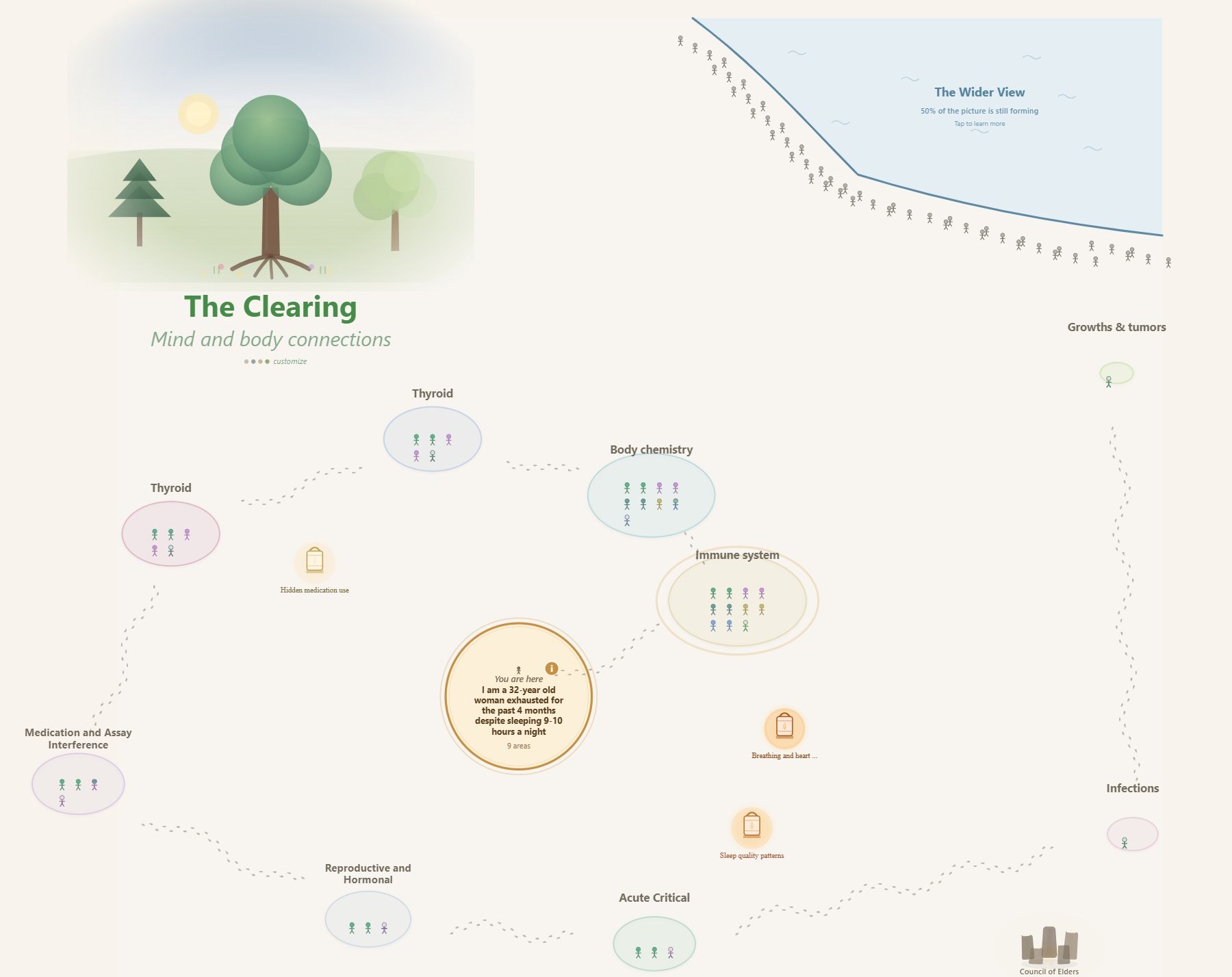
Patient Health Map: warm earth-tone neighborhoods including Thyroid, Body chemistry, Immune system, Reproductive and Hormonal, with a central persona village marked 'You are here' and the Wider View slope showing the unknown

Your symptoms become a navigable landscape. Most neighborhoods are manageable. The ones that need attention are clearly marked.

The hard part isn’t the diagnosis — why we built this →

An example case

See a real Health Map in action.

A real example: a 32-year-old woman with fatigue, weight loss, and hair loss. Explore the neighborhoods, read the explanations, see what your doctor would notice.

"32-year-old woman with fatigue, weight loss, and hair loss."

A complete map: possibilities organized into neighborhoods, with the ones to keep an eye on clearly marked. Tap any neighborhood to see what it means. No login required.

Watch how it works

A 4-minute walkthrough

Watch a complete patient journey — from telling your story to walking into your appointment prepared.

3 min 46 sec · click CC in the player for captions.

Three steps to understanding your symptoms

1

Tell your story

Your TerrainDx guide asks the right questions and listens carefully. No medical jargon. Just a conversation about what you're experiencing, in your own words. It helps you organize your story the way a doctor needs to hear it.

2

See your map

Your symptoms get organized into neighborhoods — groups of possibilities that share something in common. You'll see 60 to 100 possibilities mapped out, from the everyday to the uncommon. Most of them are manageable. The ones that need attention are clearly marked. This isn't a verdict — it's a map of what's possible.

3

Walk into your appointment prepared

Share your map with your doctor in one tap — completely free for them. They'll see your organized story, the full landscape, and the questions that matter most. You become the best-prepared patient they've seen all week. And you'll understand why your doctor's expertise matters in ways AI alone can't replicate.

"80% of the possibilities in your case are normal, manageable things. There's a logical order of sorting them out, and we have time to actually explore." — Paul Foster, MD, founder

Why this is different from Dr. Google

The full picture, not a scary list

Search engines rank possibilities by what people search for — not by what your doctor would consider. TerrainDx organizes the full landscape: the everyday things alongside the serious ones, in proportion.

Built by a doctor who has spent a career on how the visit could go better

Paul Foster, MD — 25 years of internal medicine, 15 of those training residents. He spent that career thinking about how patients and physicians can work better together — what helps a visit land, and what helps the patient walk out clearer. Meet Dr. Foster →

Your doctor gets it free

Sharing is one tap. Your doctor sees the same map — no install, no account, no cost. A shared instrument, not another app.

You'll understand why you need your doctor

The map shows the terrain. Navigating it — what to test, what to watch, what to do next — is your doctor's expertise. The tool exists to make their judgment more useful, not less.

How sharing works

Your map becomes a bridge between you and your doctor.

Common questions

Things people ask before they start.

What is TerrainDx?
TerrainDx is a tool that helps you organize what's going on with your health into a map — the full landscape of possibilities your doctor would consider, not just the scary thing that came up first on a search. It's not a diagnosis; it's preparation. You tell your story, and the system organizes it into neighborhoods of related possibilities so you can walk into your appointment with a clear picture of what to ask about.
How does TerrainDx differ from researching on Google or ChatGPT?
Search engines rank by what's popular — so the scariest thing tends to come up first. TerrainDx uses the same Bayesian reasoning your doctor uses, organizes the landscape in proportion, and lets your doctor see the same map you do.
How can I download the TerrainDx app?
There's nothing to download. TerrainDx runs in any web browser on your phone, tablet, or computer — open patient.terraindx.co, sign up, and you're in. No install, no software updates, and your doctor doesn't need to download anything either to view a map you share with them.
What is the Early Access List or beta?
TerrainDx is in select beta — we're onboarding a small group of patients to refine the experience before broader release. Send a note to our contact form to be considered for the next cohort. We read and reply to every one.
Who is Henry?
Henry is your guide through the map — a friendly park ranger character who walks you through what each neighborhood means and points out the lanterns (the questions that would change the picture). He's there to help you make sense of the landscape and feel less alone with the unknown. He isn't a doctor and doesn't give medical advice; he's a guide.
How long does it take to build a map?
A few minutes to enter your story. The full picture takes 10–20 minutes to come together — a panel of specialty-trained tools works through your case the way a multidisciplinary team would. The smart move is to enter your case before your appointment so the map is ready when you arrive.
Can I use TerrainDx to track symptoms over time?
Yes. The diary feature lets you log how symptoms evolve — small entries over time build a richer story, useful for your next appointment and for re-running your map if something changes. It works particularly well for chronic and recurring conditions.
Does it work for chronic or unexplained conditions?
Especially well. Chronic and recurring symptoms are exactly where ranked-list AI tends to flatten — and exactly where the full landscape helps most. The diary feature lets you track how symptoms evolve over time so the map updates with new information.
Will this make me more anxious?
It's designed to do the opposite. The full landscape lets your worst fear sit in proportion against the everyday possibilities. Most of any map is manageable conditions — the few that need faster evaluation are clearly marked. Knowing what's on the table makes most people feel less in the dark, not more.
What does my doctor actually see when I share my map?
The same map you see, viewable in any browser — no login, no install. They see your story in your words, the organized landscape of possibilities, and the questions that would shift the picture either way. They get the full clinical context up front, with the reasoning behind every probability traceable.
What if my doctor doesn't open the link?
Bring it to your appointment on your phone. Reading the map together, even briefly, is one of the most useful things you can do — it gives the doctor a head start without any prep on their end. You can also print the structured summary and hand it over.
How much does it cost? Can I pay with FSA or HSA?
Pricing details and beta access information are available on request via our contact form. FSA/HSA eligibility for digital health-information tools depends on your administrator's policies; ask whether decision-support tools that prepare you for clinical visits are reimbursable under your plan. We're happy to provide documentation on request.
Can I delete my data?
Yes — at any time, from your account settings. When you delete, we don't keep copies. If you want to delete your entire account, we'll honor that within a reasonable processing window.
Can I take my data with me if I leave?
Yes. Every map can be exported as a structured summary (the same one you share with your doctor) or printed as a clean PDF. If you cancel a subscription, your maps stay as printable views you can keep — they don't disappear.
Should I use this instead of calling my doctor?
No. TerrainDx helps you prepare for the conversation, not replace it. If you're experiencing a medical emergency, call 911.
What information should I include — and what should I leave out?
Tell your story in your own words: symptoms, when they started, what they feel like, what you've tried, anything your doctor has said so far. You should NOT include your real name, date of birth, Social Security number, or insurance information — we don't need them and you should never enter them. If you want to share with your doctor, the secure link does the introduction; you don't need to identify yourself in the case text.
What happens to my data — privacy, security, and HIPAA?
Your map is yours. We use industry-standard encryption in transit and at rest. Nothing is shared with anyone — including your doctor — until you tap to share. We never sell information. Your map is a personal health record under your control; for many use cases this means you can share with anyone you choose, anytime, without HIPAA business-associate requirements applying to us. If you have specific questions about HIPAA coverage for your situation, ask us at our contact form.

Age: TerrainDx is intended for adults. We recommend any educational use with teenagers be done in a collaborative setting with a parent or guardian.
More questions?
"Your doctor is more of a mountain guide. You have a mountain to climb, and they have the tools to walk you through it — quick, safe, with a relationship really built on healing and support." — Paul Foster, MD, founder

Want to hear when TerrainDx launches?

We're refining the experience with a small group of patients before broader release. Send us a note and we'll keep you posted.

Request information on the release of TerrainDx paul@terraindx.co · we read and reply to every note

TerrainDx is an information tool designed to help you prepare for medical care. It does not diagnose, treat, cure, or prevent any disease or condition. Always discuss symptoms and decisions with a licensed clinician.